Sermon for the First Sunday after Trinity

Click here to listen to audio file of Matins & Ante-Communion for the First Sunday after Trinity

“This commandment have we from him, that he who loveth God love his brother also.”

And if we don’t? Then we have the powerful story of our denial of God’s love by our complete neglect of one another. Lazarus is lying at our feet. How we deal with one another is entirely grounded in our relation to God. Make no mistake, the parable of Lazarus and Dives, the rich man, speaks directly and profoundly to the forms of “the malaise of modernity.” The term is not mine; it was used a long time ago by Charles Taylor, Canada’s ‘pre-eminent’ philosopher. We live now in the collapse and disarray of the institutions that in their truth contribute to the dignity and ennobling of human existence. This  compels an awakening of an ethical attitude towards the world of which we are a part; a corrective and critique of ourselves.

The lessons for the First Sunday after Trinity are particularly instructive and challenging. The Epistle reading from 1 John 4 encapsulates the meaning of Trinity Sunday quite profoundly. It is remarkably simple: “God is love; and he that abideth in love abideth in God, and God in him,” to use the older translation that remains in the Scriptural sentences as the refrain of the Trinity season. It is at once so familiar as to be completely overlooked and ignored. Perhaps that is why we need the accompanying Gospel reading from Luke 16 to point us to the radical meaning of the commandment to love, paradoxical as that may seem. For the parable is a telling indictment of our neglect of God through our neglect of one another. The point is not that the world is a problem; we are the problem. We create the gulf, the abyss between ourselves and God, between ourselves and the world, and between one another through our indifference and neglect.

The dangers are very real. This week has confronted us with the heart-breaking spectacle of the unmarked and concealed graves of native children who died in the Residential Schools system, neglected and ignored by those to whose care they were entrusted. It is a sad story and another blow to the quest for respect and dignity of Canada’s native peoples, many of whom remain deeply committed Christians, hence the touching spectacle of love and compassion in the placing of children’s shoes on the steps of churches. It makes visible the desire to be seen and remembered, and not to be neglected and ignored.

The parable is about the realities of neglect and indifference. It turns us to the literal ground of our lives; Lazarus on the ground at our feet. In that sense, the First Lesson at Matins from the Book of Joshua complements the Gospel. The Book of Joshua is about the conquest of the promised land but as the lesson makes clear that is entirely based on God’s Word and Will as the defining feature of Israel.” Be strong and of good courage; be not frightened, neither be dismayed; for the Lord your God is with you wherever you go.” Words which have a certain power and resonance for us in the present. Just so the Second Lesson from Mark makes clear that the land is also a place of teaching and healing, indeed, spiritual healing. Jesus teaches “as one who had authority”, the ultimate authority of God, the one who raises to life and casts out demons.

(more…)

Print this entry

The First Sunday After Trinity

The collect for today, the Second Sunday after Pentecost, commonly called The First Sunday after Trinity, from The Book of Common Prayer (Canadian, 1962):

O GOD, the strength of all them that put their trust in thee, mercifully accept our prayers; and because through the weakness of our mortal nature we can do no good thing without thee, grant us the help of thy grace, that in keeping of thy commandments we may please thee, both in will and deed; through Jesus Christ our Lord. Amen.

The Epistle: 1 St. John 4:7-21
The Gospel: St. Luke 16:19-31

Nikolaus Knüpfer, Lazarus at the Rich Man's GateArtwork: Nikolaus Knüpfer, Lazarus at the Rich Man’s Gate, ca. 1630-40. Oil on panel, Brera, Milan.

Print this entry

Boniface, Missionary, Bishop and Martyr

The collect for today, the Feast of Saint Boniface (Wynfrith) of Crediton (c. 675 – 754), Bishop, Apostle to the Germans, Patron Saint of Germany, Martyr (source):

O God our redeemer,
who didst call thy servant Boniface
to preach the gospel among the German people
and to build up thy Church in holiness:
grant that we may hold fast in our hearts
that faith which he taught with his words
and sealed with his blood,
and profess it in lives dedicated to thy Son,
Jesus Christ our Lord,
who liveth and reigneth with thee,
in the unity of the Holy Spirit,
one God, now and for ever.

The Lesson: Acts 20:17-28
The Gospel: St. Luke 24:44-53

Christian Wilhelm Ernst Dietrich, Saint Boniface Felling the Sacred OakArtwork: Christian Wilhelm Ernst Dietrich, Saint Boniface Felling the Sacred Oak, 18th century. Oil on canvas, Scottish National Gallery, Edinburgh.

Print this entry

KES Chapel Reflection, Week of 3 June

Lazarus, come out

This would have been the week of ‘last Chapels’, a time of reflection and an attempt to gather up, in my own poor fashion, the meaning of Chapel in the educational life of the School. I want to think about an extraordinary scene in John’s Gospel about Jesus’ engagement with our humanity at times of death; his encounter with us as mourners.

It is the scene of the raising of Lazarus (John 11.38-43). It is the last of three occasions in the Gospels where Jesus meets us as mourners. There is, first, the story of Jesus’ raising the daughter of Jairus who has just died. Talitha cumi, “Little girl, I say to you, arise,” Jesus says in the face of the sceptical ridicule of the attendants (Mark 5. 35-43). It is one of the few Aramaisms, words in Aramaic in the Gospels but then translated into Greek.

There is, secondly, the wonderful story of his encounter with the Widow of Nain on her way in grief to bury her only son. We are meant to feel her grief, her loss, and the way in which the community grieves with her. Yet “do not weep,” Jesus says to her and then to the young man, he says, “arise.” He sat up, we are told, “and began to speak.” And in a marvelous touch, Luke tells us, Jesus “gave him to his mother” (Luke 7.1-17). The story identifies the active principle that moves in all these encounters. “When the Lord saw her, he had compassion on her.” It is only on that basis that Jesus can say to her, “do not weep,” meaning, ‘don’t always be weeping’. The divine compassion shown through the humanity of Christ grounds our life in God’s life and as such we are not simply defined by suffering and death, by grief and sorrow. Instead through suffering and death we participate in God’s own life. Such is the meaning of these encounters.

The raising of Lazarus takes place in the context of Jesus with Mary and Martha, the sisters of Lazarus. An intriguing story, it names the divine reality of the triumph of life over death for us as resurrection. Jesus says explicitly to Martha, “I am the resurrection and the life,” radical words which belong to the deep insight of the religious and philosophical traditions in their Christian form. God is life and that life is made known in all of its wonder and mystery in Christ. Lazarus has been dead four days, as Martha points out, saying that “by this time there will be an odor” (or as the King James Version more graphically puts it, “Lord, by this time he stinketh”!). All of these encounters are emphatic about the reality of the body and death. All of them show Jesus not just as another mourner. He is with us in our griefs – they are not denied any more than death is denied – but death is overcome. The Resurrection of Christ testifies to the radical nature of human individuality in and through suffering and death. These stories show us the truth and dignity of our humanity as found in the love of God. That alone changes everything and sets us in motion towards one another in knowledge and love.

(more…)

Print this entry

Justin Martyr

The collect for today, the Feast of Saint Justin (c. 100 – 165), Philosopher, Apologist, Martyr at Rome (source):

Jacques Callot, Justin Martyr presenting an open book to a Roman emperorO God our redeemer,
who through the folly of the cross
didst teach thy martyr Justin
the surpassing knowledge of Jesus Christ:
free us, we beseech thee, from every kind of error,
that we, like him, may be firmly grounded in the faith,
and make thy name known to all peoples;
through Jesus Christ thy Son our Lord,
who liveth and reigneth with thee,
in the unity of the Holy Spirit,
one God, now and for ever.

The Epistle: 1 Corinthians 1:18-30
The Gospel: St. Luke 12:1-8

Artwork: Jacques Callot, Justin Martyr presenting an open book to a Roman emperor, c. 1632-1635, engraving.

Print this entry

Sermon for Trinity Sunday

Click here to listen to audio file of Matins & Ante-Communion for Trinity Sunday

“No one has ever seen God; the only-begotten Son, who is in the bosom of the Father,
he has made him known.”

“Now the Catholic Faith is this, that we worship one God in Trinity, and the Trinity in unity.” A surprising and startling statement, it may seem, and yet it belongs not only to the Athanasian Creed but to the central logic and meaning of the Christian Faith. God is Trinity though the word Trinity appears nowhere in the Scriptures. It appears first in the writings of Theophilus of Antioch writing in Greek in the second half of the second century, albeit in a peculiar form, and then in the Latin writings of Tertullian in the late decades of the same century. Yet it belongs to the revelation of the essential life of God and to the equally essential task of our thinking God. The first section of the Athanasian Creed ends with the words: “He therefore that would be saved, /let him thus think of the Trinity,” think of the Trinity in this way, the way of affirmation and negation in the dance of apophatic and kataphatic theology that is the Athanasian Creed. Pretty strong stuff. Can we really think this?

It is the essential proclamation of the Christian Faith but far from being something exclusive and forbidding, exotic and remote, speculative and abstract, it is the doctrine, the teaching, that requires and provides the basis for the Christian engagement with other religions and faiths and with ourselves. In short, the divine self-relation which the Trinity is and reveals offers the connection to the universal idea of thinking God without which we cannot think ourselves. It is not about some form of Christian triumphalism or supersessionism – the idea that one religion or philosophy supersedes another or that the latest fancy or fantasy is by definition the best.  It connects us instead to the quest for wisdom that belongs to the radical truth of our humanity.

“No one has ever seen God,” John tells us. He states a simple truth. God is nothing, no thing among other things, not an object, not a thing, but rather the very ground of the being and knowing of all things. What John highlights here belongs to his thinking deeply and profoundly upon the words of Christ. “Apart from me you can do nothing,” for instance; “Before Abraham was, I am,” and so forth. These are radical words which speak about God in himself without which we are nothing, not even selves. As John rightly intuits, the truth of God is revealed in the only-begotten Son, who ever is and never was not. His words compel us and challenge us. That is the meaning of the Gospel lesson about Nicodemus coming to Jesus in the hiddenness of the night. The meaning is about how we have to think about things in a radically new and different way; literally, to be born again, into a new way of understanding.

(more…)

Print this entry

Trinity Sunday

The collect for today, the Octave Day of Pentecost, commonly called Trinity Sunday, from The Book of Common Prayer (Canadian, 1962):

ALMIGHTY and everlasting God, who hast given unto us thy servants grace, by the confession of a true faith, to acknowledge the glory of the eternal Trinity, and in the power of the Divine Majesty to worship the Unity: We beseech thee, that this holy faith may evermore be our defence against all adversities; who livest and reignest, one God, world without end. Amen.

The Lesson: Revelation 4:1-11
The Gospel: St. John 3:1-15

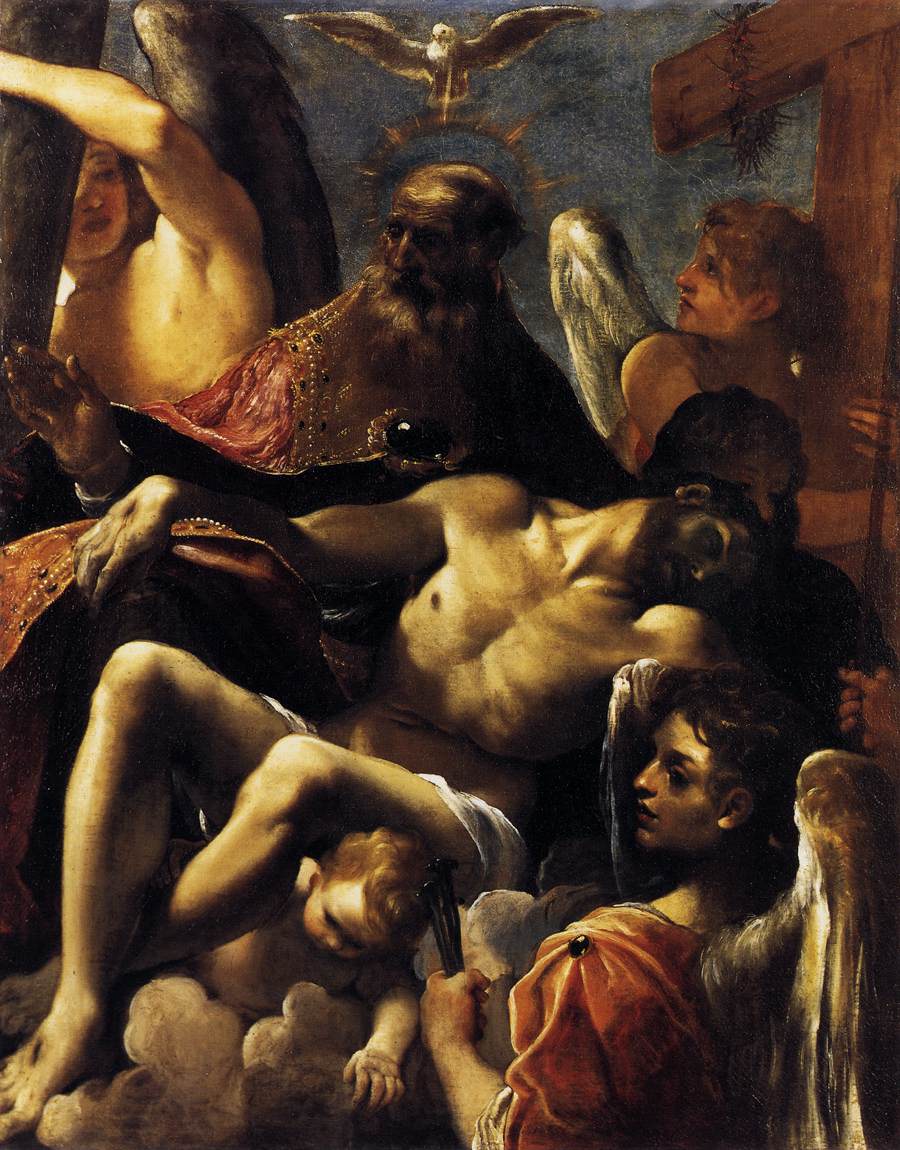
Ludovico Carracci, The Trinity with the Dead ChristArtwork: Ludovico Carracci, The Trinity with the Dead Christ, c. 1590. Oil on canvas, Pinacoteca Vaticana.

Print this entry

KES Chapel Reflection, Week of 27 May

In the name of the Father, and the Son, and the Holy Ghost

How many times have you heard that said in Chapel! A text, usually taken from the Scripture reading by one of you in Chapel, and then these words are added to it at the beginning and end of the homily. What does it mean? Simply this. The Chapel services at King’s-Edgehill School are explicitly Christian but in the awareness of the necessity of connecting the Christian understanding to the ways of thinking and speaking that belong to other world religions and philosophies. Why? Because they all contribute in one way or another to an ethical understanding of our lives together at once as selves, as a community, and as part of a global world in and through the diversities of language and culture.

The Father, the Son, and the Holy Ghost are the terms and images that belong to the Scriptural revelation of God in the New Testament and in the Christian understanding but as building upon images in the Jewish Scriptures and as drawing upon imagery and language from Greek culture. The point is not the cultural specificity of such things; the point is the universality of meaning that belongs to a consideration of the dignity of our common humanity.

But such familiar if mysterious words also point to an important feature of Chapel at the School. It is simply this: no name religion is no religion. It is only through the integrity of theological thought that one can engage in a respectful and responsible way with the different forms of thinking about reality that is an essential feature of education and of Chapel. The doctrine of the Trinity is the highest form of the Christian thinking about God; yet it compels a commitment and relation to other traditions, a thoughtful, responsible and dignified engagement which honours the late Rabbi Jonathan Sacks’ idea of “the dignity of difference” between and among the religions and philosophies of the world.

What does it mean in the context of the Chapel service? Simply this. With these words, I place myself under an authoritative tradition and theological way of thinking. The homilies are not simply my poor words and endeavours to communicate or to entertain (hardly!). They are nothing apart from the words of Scripture which they attempt to serve. They are little more than an explication of the understanding of the images of Scripture, an attempt to connect through what has been communicated in the truest form of preaching, namely, the proclamation of the Word by you or your fellow students, words which provoke thought and challenge our thinking.

(more…)

Print this entry

Sermon for Pentecost

Click here to listen to audio file of Matins & Ante-Communion for the Day of Pentecost

“And suddenly there came a sound from heaven, as of a rushing mighty wind”

Sometimes the things that come upon us suddenly unsettle us most of all. We live in rather unsettling times because of the Covid-19 pandemic and all of the disruptions that it has occasioned. This prompts the question as to whether we are simply and completely determined by things outside our control. To be blunt, you cannot blame Covid-19 on Christ Church or Windsor or Nova Scotia or Canada or China or Wuhan. It is not so simple. It is a modern pandemic which has to do with global mobility and the inequalities socially and economically among so many in our so-called global world. We are all, in that sense, completely implicated in our current unsettledness. Everything comes down to the spirit in us by which we confront our struggles and concerns; in short, about how we think about ourselves in relation to one another.

Perhaps, just perhaps, Pentecost might provide us with a way to think about things more universally and yet profoundly local. There are things which unsettle us, perhaps, never more so than in these unsettling times. But is it so with the Descent of the Holy Ghost? He came down suddenly upon the disciples, we are told, but was his coming suddenly a coming unexpectedly? That he came suddenly we read, his coming unexpectedly we do not read. In fact, Jesus tells us to expect the coming of the Holy Ghost “commanding them not to depart from Jerusalem but to wait for the promise of the Father,” even the descent of the Holy Ghost. We are meant, it seems, to be settled upon what comes to us even in unsettling times.

Yet we may wait expectantly and still be caught unawares, for the realisation of what we await may far exceed our expectations and so catch us by surprise. We await for what we do not fully understand. The grace of God is always something more; the mystery of God something more yet again. The promise of the Ascension was the coming down of the Holy Ghost for which Jesus prepares us and bids us wait, yet “suddenly there came a sound from heaven, as of a rushing mighty wind.”

Certainly, the effects of this coming down would appear to be most unsettling, the manner of their appearing no less so – “a rushing mighty wind” and “cloven tongues like as of fire,” lighting upon the disciples gathered in Jerusalem filling them with the Holy Spirit and moving them “to speak with other tongues.” To all appearances an event most unsettling, at once exotic and ecstatic.

We all know about the winds that unsettle us – the rushing mighty winds of rumour and slander, of whisperings and murmurings, of allegations and accusations which seek to belittle and destroy. The winds of hatred and revenge, of judgement and accusation, are the winds of death. These are the winds that unsettle us as sure as the sea-storms which come up suddenly and trouble our ships upon the waters. But in our current situation, we live in the midst of other uncertainties, the uncertainties of those claiming to speak in the chimera of ‘science,’ those who rightly demand our acquiescence to this restriction and this but at the same time suggesting their own uncertainty, their own sense of the provisional and the uncertain which belongs, to be sure, to the truth of modern science.  To be up-front about this is really about transparency and honesty, a check on our presumption and pride. To be patient about all of the forms of uncertainty that swirl around us is our current struggle and demand, a check upon our frustrations and judgements.

(more…)

Print this entry

The Day of Pentecost

The collects for today, The Day of Pentecost, being the fiftieth day after Easter, commonly called Whit-Sunday, from The Book of Common Prayer (Canadian, 1962):

O GOD, who as at this time didst teach the hearts of thy faithful people, by the sending to them the light of thy Holy Spirit: Grant us by the same Spirit to have a right judgement in all things, and evermore to rejoice in his holy comfort; through the merits of Christ Jesus our Saviour, who liveth and reigneth with thee, in the unity of the same Spirit, one God, world without end. Amen.

O GOD, who makest us glad with the yearly remembrance of the coming of the Holy Spirit upon thy disciples in Jerusalem: Grant that we who celebrate before thee the Feast of Pentecost may continue thine for ever, and daily increase in thy Holy Spirit, until we come to thine eternal kingdom; through Jesus Christ our Lord. Amen.

The Lesson: Acts 2:1-11
The Gospel: St. John 14:15-27

Jacques Blanchard, The Descent of the Holy SpiritArtwork: Jacques Blanchard, The Descent of the Holy Spirit, May 1634. Oil on canvas, Baptismal Fonts Chapel, Notre-Dame de Paris.

Print this entry